Share This

Thursday, 19 June 2014

"Super" banana to face first human trial

"Super" banana to face first human trial
SYDNEY: A super-enriched banana genetically engineered to improve the lives of millions of people in Africa will soon have its first human trial, which will test its effect on vitamin A levels, Australian researchers said Monday.

The project plans to have the special banana varieties -- enriched with alpha and beta carotene which the body converts to vitamin A -- growing in Uganda by 2020.

The bananas are now being sent to the United States, and it is expected that the six-week trial measuring how well they lift vitamin A levels in humans will begin soon.

"Good science can make a massive difference here by enriching staple crops such as Ugandan bananas with pro-vitamin A and providing poor and subsistence-farming populations with nutritionally rewarding food," said project leader Professor James Dale.

The Queensland University of Technology (QUT) project, backed by the Bill and Melinda Gates Foundation, hopes to see conclusive results by year end.

"We know our science will work," Professor Dale said.

"We made all the constructs, the genes that went into bananas, and put them into bananas here at QUT."

Dale said the Highland or East African cooking banana was a staple food in East Africa, but had low levels of micro-nutrients, particularly pro-vitamin A and iron.

"The consequences of vitamin A deficiency are dire with 650,000-700,000 children world-wide dying ... each year and at least another 300,000 going blind," he said.

Researchers decided that enriching the staple food was the best way to help ease the problem.

While the modified banana looks the same on the outside, inside the flesh is more orange than a cream colour, but Dale said he did not expect this to be a problem.

He said once the genetically modified bananas were approved for commercial cultivation in Uganda, the same technology could potentially be expanded to crops in other countries -- including Rwanda, parts of the Democratic Republic of Congo, Kenya and Tanzania.

"In West Africa farmers grow plantain bananas and the same technology could easily be transferred to that variety as well," he said.

Sunday, 15 June 2014

Living Lawn Mowers on Roof Garden

Living Lawn Mowers on Roof Garden

Vertical Gardening For Space Utilization and Landscaping


This time of year provides good “thinking” time regarding gardening. It is a time to look back on what went well and what could stand some improvement.

For example, if it seems that your yard needs some more oomph or pizzazz, but you can’t quite put your green thumb on what would help, try looking up and consider growing more plants vertically. It’s a change of perspective that adds interest to your outdoor living space.

Climbing plants are somehow more welcoming, with their living beauty embracing you. In addition, if your yard space is limited, trellises and other support structures make the most of the space you have. Because vines grow upward, you don’t have to worry about them spreading. Also, you may be able to use previously unused areas to add color and interest.

It’s wise to consider the structures you will use before buying plants. Metal, wood, plastic — what fits your garden’s style? What materials do you already have in fences, for example, that would harmonize with a new vine support? Supports can include arbors, trellises, tepees made of branches or bamboo, cages (tomato or bird), string, fences or a major structure such as a pergola.

While a rustic-looking trellis you make from the leftover trimmings from a tree will look charming in a casual garden, it might look out of place in a more formal garden or near a house of modern architecture. Use a design that goes well with its surroundings. Light-colored or white supports create a bold contrast to the mostly green plants that will grow on them. Brown and green structures blend more readily into their surroundings.

Vines can hide or soften fences or other things you’d like to hide. The “cyclone fence” in my backyard looks ever so much better with grapes growing on it. A smaller, softer vine like a passionflower can do wonders to make a sturdy wooden fence seem less so. If you have a dead tree that it would be difficult to remove, plant something substantial-looking, such as a climbing hydrangea, near it. Screen the view of your compost pile, perhaps, or of your neighbor’s backyard.

Consider scale when choosing a support, keeping in mind the plant with which you’d like to pair it. Some vines, such as wisteria or climbing roses, get thick and heavy and need some heft in their support, but a morning glory or moonflower would look out of place on a structure made of two by fours.

Some ideas for vines you might try include morning glory, sweet peas, clematis, scarlet runner beans, sugar snap peas, hops, passionflower, climbing roses, jasmine, honeysuckle, grapes, climbing hydrangea, wisteria, trumpet vine, kiwi and moonflower. And I love my mandevilla on the arbor straddling a flagstone path, even if it takes extra care to keep it alive over the winter.
Building a structure for a vining plant might be a good winter project. Next spring, as you install it before planting, be sure to set it securely, as this is something you want to get right the first time. Set it in the ground even deeper than you might think necessary. Large, heavy structures might need concrete footings.

With some planning, a vertical garden is delightful — it may even become the focal point for your outdoor living area. With its beauty displayed right at eye level, it will be a feast for your senses.
Vertical Gardening For Space Utilization and Landscaping

Tuesday, 10 June 2014

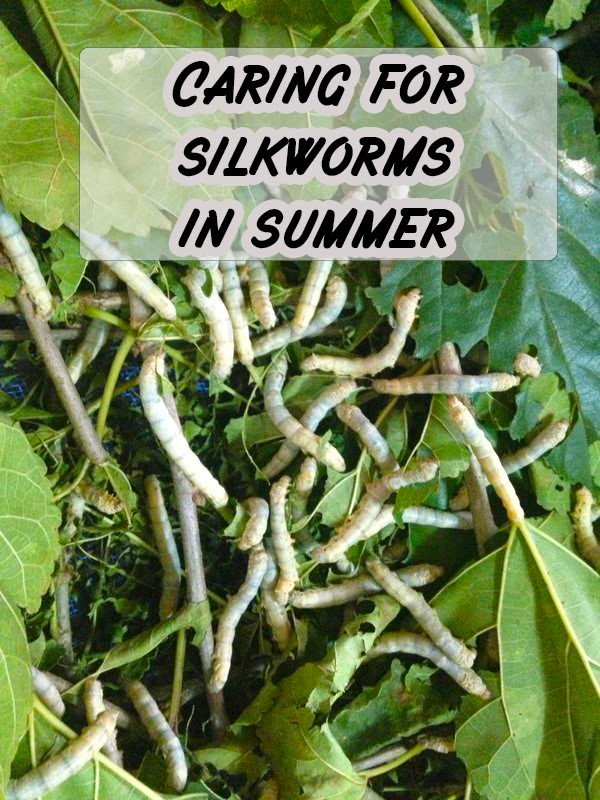
Caring for silkworms in summer

 Life Stages of Silk Worm
Life Stages of Silk Worm


Robust growth of silkworms and silk yield are directly influenced by the quality of mulberry leaves fed.

At the same time, climatic condition also plays an equal role as the silkworms are sensitive to the temperature and other abiotic factors.

Silkworms prefer cool climate with moderate humid condition. But in tropical zones, silk productivity is generally low in summer season mainly due to hike in temperature, fall of humidity and other factors like water scarcity, pests in mulberry garden and outbreak of diseases.


Adverse effects


Many farmers partially irrigate mulberry gardens in summer due to water scarcity which yields leaves with poor moisture content. Feeding such leaves results in adverse effect on growth of silkworms and their immunity. Therefore farmers often face crop failure in summer because of disease outbreak.

Earmark mulberry gardens for silkworm rearing according to the availability of water to ensure sufficient irrigation. The leftover gardens can be kept idle without pruning of plants till monsoon.

Drip irrigation helps save water. Black polythene mulching in mulberry garden conserves soil moisture for long time besides controlling weeds and enhances mulberry leaf yield and quality.

Dry and hot conditions result in fast evaporation of moisture from the leaves offered to the worms in the rearing bed and they dry before ingestion. Therefore the growth of worms and silk yield are affected.

Cool atmosphere


Grow trees around the rearing shed to avoid direct sunlight falling on the walls and to keep the atmosphere cool naturally.

Hang moistened gunny cloths around the rearing shed for flow of cool and humid air inside.

Summer encourages sucking pests like thrips, pink mealybug, papaya mealybug etc in mulberry garden which deteriorate the leaf quality. Spray strong jets of water to wash out the pests from the plants.

Release suitable predatory parasitoids in the affected garden according to the pest species. Avoid use of toxic chemicals.

(Dr. N.Sakthivel and Dr. Chikkanna are Scientists, Research Extension Center, Central Silk Board, Srivilliputtur – 626 125, Tamil Nadu & Regional Sericultural Research Station, Salem – 636 003, email: sakthivelcsb@hotmail.com, Mobile: 098427 61789.)

Caring for silkworms in summer

Friday, 6 June 2014

I Want a World

I don't Want to Protect the environment I want to create a world where the environment doesn't need protecting.

Wednesday, 4 June 2014

Growing Lemon Trees

How to Grow Lemon Trees

By Rifat Abro
The Dawn

A LEMON tree is a sub-tropical plant, and in its natural habitat, its fruit is green and only slightly acidic for the fruit to develop its flavour and yellow color.

The fruit is picked before maturity to preserve its acidity. Most of the species under the genus lemon are native to tropical and sub–tropical regions of southeast Asia, particularly, India, China.

Lemon juice is valued in the home as a stain remover, and a slice of lemon dipped in salt can be used to clean copper-bottomed cooking pots. Lemon juice has been used for bleaching freckles and facial cleansing creams. Lemon peel oil is much used in furniture polishes, detergents, soaps, and shampoos.

This citrus fruit ranks very high in its medicinal value, having many therapeutical uses. Lemon juice is a natural antiseptic which may be safely applied directly to cuts, bruises and infections. Lemon juice is good for asthma, headaches, pneumonia, and arthritis. It is a good general blood and body purifier and a mild diuretic. It is important in perfume blending and especially in colognes.

Lemon is grown in both dry and humid atmospheres, the latter being a disadvantage mainly in the processes of curing and storing. The lemon tree has the reputation of tolerating very infertile, very poor soil.

Recommended soils are sand, clay and sandy–clay–deep, with high permeability and good drainage. Black soils are also suitable if not lying over calcareous sub-soil. Ph should be between 5.5 and 6.5. If acidity is high, it is necessary to apply lime to achieve the optimum level.

Usually, lemon is planted in pits of 50 x 50 x 50cm or of 75 x 75 x 75cm sizes in square system with spacing of 5 to 8 m depending upon the species and rootstocks. For rough lemons or karana khatta wider spacing of 5 x 5 m is adequate.

Though the planting is usually done during the monsoon season, it is better not to plant at the time of heavy rains to avoid any water logging near the planting pits. Weather should not be too wet or too dry at the time of planting.

The rough lemon is widely grown from seed. The ‘Meyer’ lemon is easily reproduced by rooting large cuttings in the nursery and planting them directly in the grove. They fruit two to three years sooner than budded trees and have a long life, remaining in full production for over 30 years, perhaps much longer. In case of lemons, cutting and layering (air layering) are commonly employed and plants thus raised develop shallow but good root system.

Remove congested growth in early spring, and pinch out shoot growing tips in summer. If renovation is required prune back by two-thirds in early spring. Pruning lemon trees should be confined to trimming extremely long branches that become untidy or new branches that cross over others, they do not require any special pruning to encourage flowers as these will be produced naturally shoot tips and wood old enough to bear them.

Irrigation is of vital importance to lemon orchard and it is considered as one of the most critical culture operations. About the method of irrigation, suggested that young trees up to eight years may be profitably irrigated by basin system. Other irrigation methods applied are flood, furrow, sprinkler methods.

The application of irrigation in right time and in right quantity is more important than the method of irrigation. Usually, under local condition weekly irrigation during March to June and fortnightly irrigation during November to February are practiced.

For sustained production and to maintain proper orchard health it is essential to apply manures and fertilisers to lemon orchard regularly. For non–bearing tree, fertiliser application may be done in an area more than drip circle, leaving 15 -30 cm radius around the tree trunk.

The marketability of lemons depends on the stage at which they are picked. Lemons were allowed to remain on the trees until they became too large. It was realised that early picking is necessary.

Some growers adopted the practices of picking at any time after the fruits reach 25 per cent juice content, and using rings to gauge the commercially acceptable size, and repeated spot-picking with clippers. Mechanical picking is impossible with lemons. The fruits are highly prone to oil spotting (oleocellosis) and cannot handle roughly nor picked wet.

In Pakistan, a 6-year-old tree bore 966 fruits and at 9 years of age, had produced a total of 3,173 fruits.

Friday, 30 May 2014

Mealybugs Management in Greenhouse

Mealybugs Management in Greenhouse

Chilling greenhouse plants upto 36F (2.2C) for two days could deter mealybugs for atleaset 2 straight months. Two days chilling most likely dont affect the health of the plant and is organic way to curb the infestation.


Mealybugs Management in Greenhouse

Wednesday, 28 May 2014

No War Garden

Palestinian woman collects tear gas canisters fired by Israeli Army. She grows flowers in them.

Monday, 26 May 2014

Rabbit Farming for Meat

Rabbit Farming for Meat


To fulfill the food demand for growing population, we have to find out different ways of food production. The rabbit known as "Micro-Livestock" can be a great source of food production. 

There is a great opportunity of rabbit farming in our country. Rabbit needs small place and less food for survival. Rabbit meat contains high ratio of protein, energy, calcium and vitamin than other species of animal.

The cholesterol fat and sodium is less than other meat. The meat of rabbit is very testy, easily consumed and all religious people can eat it. They grows very fast and the female rabbit produce 2-8 baby every time.

They eat very low quality food and make high quality of meat. Raising rabbit can be a great income source to the unemployed people and landless farmers. So, we have to raise rabbit to meet the demand of protein as well as to reduce poverty from our society.

We generally raise rabbit as pet. But if we raise them commercially then it will be a great source of income and a smart way of employment. The annual demand of meat in our country is about six million tons. But only one million tons of meat produced in our country, rest of the meat we import from foreign country.

According to the demand only 15-20 percent of animal protein comes from the livestock which is very less compared to the requirement. Further, this demand is increasing with population growth.

An adult person needs 120 grams of meat daily. But we get only 20 grams on an average. So, we can consider rabbit farming as a potential direction of animal protein. It is very easy to maintain rabbit farm than other animals. Every person of the family can take care of it.


Species of Rabbit:


There are many species of rabbit are available in our country. Among those Dark Gray (internal), Fox, Dutch, New Zealand White, New Zealand Black, New Zealand Red, Belgium White and Chinchilla are most favorite.

Rabbit Meat Quality


In many research it has found that, young rabbit meat is very high quality than the adult rabbit meat. And the meat quality of male rabbit is high than female rabbit meat.

The quantity of cholesterol and lipids increases and reduces protein with the increase of the rabbit age. On the other hand, female rabbit meat contains more lipid, fat and cholesterol.

Benefit of Rabbit Farming:


There are many benefits of farming rabbit. The main benefits of raising rabbit according to our country economic and ecological condition are described bellow.

  • The rabbit is a very fast breeding animal.
  • Their food converting rate is better than other animals.
  • One female rabbit can give birth 2-8 baby rabbit at a time.
  • Rabbit can be raised in a short place.
  • More production can be made in little cost.
  • Rabbit meat is very nutritious.
  • In meat production it has a place after poultry.
  • Wast material of the kitchen, grass, plant leaves etc. are favorite food of rabbit. So, we can raise them using this commodities.
  • Family labor can be successfully applied to rabbit farming.

Method of Raising Rabbit:


With a small investment we can make house for rabbit in our house yard or in building roof and start rearing rabbit. We can make house for rearing rabbit in two methods.

Deep Litter Method:


This method is suitable for less amount of rabbit. The floor should well made concrete. 4-5 inches depth litter should make with husk, rice straw or wood lath. In this method at most 30 rabbit can be raised. The male rabbit should keep in a separate room from the female. In this method the possibilities of being affected by diseases is high. Moreover, it is very difficult to manage the rabbit in this system.

Cage Method:


To keep rabbit commercially this method is the best. In this system the rabbit are kept in a cage made with iron plate. This cage is very useful for raising more rabbit. In every cage it have to have the facilities of necessary space. Male and female rabbit should keep separate from each other. They should keep in same rood when thy need mating to produce baby rabbit.

Food Management


Food consuming rate and nutrient requirements varies according to the rabbit age and species. For proper nutrition of an adult rabbit its food should contain 17-18 percent crude protein, 14 percent fiber, 7 percent minerals and 2700 kilo calorie/kg of metabolic energy.

Green leafy vegetables, seasonal vegetable, spinach greens, carrots, Muller, cucumber, green grass and vegetable wast can easily used as the food of rabbit. For commercial purpose poultry food can be served to feed the rabbit. Accordance with proper food management they should supply sufficient water according to their demand. Thus a farmer can be success in rabbit farming. 

Friday, 23 May 2014

How Plants Filter The water

How Plants Filter The water

How hot is hot?

How hot is hot?


The pungency or heat of a pepper depends on seven closely related alkaloids or capsaicinoids. In the early 1900s, Wilbur L. Scoville devised a test to determine the relative hotness of different peppers. 

Capsaicin from a known weight of pepper was extracted with alcohol and mixed in various concentrations with sweetened water. Human tasters were asked to identify the point at which water neutralized the hotness. 

The volume of water required for each sample was assigned a rating in Scoville units—the larger the number, the more water needed and the hotter the pepper. A high-pressure liquid chromatography test replaced this technique in the early 1980s, but the measurements are still expressed in Scoville units. 

The following peppers are listed from most hot to least hot, according to Scoville units.

Habanero
  • Caribbean Red_______________________100,000–445,000
  • Red _______________________________80,000–285,000
  • Scotch Bonnet________________________80,000–260,000

Jamaican Hot_________________________100,000–200,000
Chiltepini______________________________50,000–100,000
Santaka
Thai
Cayenne_______________________________50,000–70,000
Charleston Hot
Piquin_________________________________30,000–50,000
Aji
Cayenne
Tabasco
Thai Dragon____________________________35,000–45,000
De Arbol_______________________________15,000–30,000
Serrano_________________________________5,000–23,000
Yellow Wax______________________________5,000–15,000
Jalapeño_________________________________2,500–5,000
Mirasol
Cascabel_________________________________1,500–2,500
Rocotillo
Sandia
Ancho___________________________________1,000–1,500
Chilaca
Espanola
Pasilla
Poblano
Anaheim___________________________________500-1,000
Big Jim
New Mexico
Cherry______________________________________100–500
Mexi-Bell
Peperoncini
Bell________________________________________________ 0
False Alarm
Pimento
Sweet Banana
Sweet Italian

How hot is hot?

Seeds Sprouting and Soaking Chart

Seeds Sprouting and Soaking Chart

Wednesday, 21 May 2014

Pink Lilies

Pink Lilies

Why should we grow guar?

Why should we grow guar?


GUAR is an important leguminous crop which is extremely drought resistant and can be grown in semi-arid regions. The guar bean has a large endosperm, which contains significant amounts of primary marketable product, guar gum. 

The guar gum, also called guaran, is extracted from the seed of the leguminous shrub Cyamopsis tetragonolobus (Leguminosae), which is grown in arid and semi-arid regions of Sindh and Punjab. It is termed as the best substitute for locust bean gums. Manufacturing of gum from its beans gives such astonishing results that it is considered 'white gold'. 

The guar is dicotyledonous (oval-shaped) seed having a diameter of about 8mm. Galactomanan is the essential ingredient of guar that gives it unique thickening, binding and stabilising properties. 

In order to obtain pure galactomanan, the endosperm is separated from the hull and germ. The relative composition of a guar seed comprises 14-17 per cent hull, 43-47 per cent germ and 34-36 per cent endosperm. The production process is optimised to extract maximum levels of galactomanan from seeds of differing content by using a multi-stage grinding and sifting process. Guar is used as cattle feed and green manure and can be eaten as a green bean. 

Guar plant grows well under a wide range of soil conditions. It thrives best in fertile, medium textured and sandy loam soils, with good structure and well-drained subsoil. Under irrigated condition it should be sown from April to July but in rain-fed regions sowing should be completed before monsoon. 

The plant cannot stand water-logging conditions, although it is considered to be tolerant to both soil salinity and alkalinity. The crop tolerates high temperatures and dry conditions, and is adapted to arid and semi-arid climates. Ideally, guar requires two showers before sowing, one spell during budding and another one at the time of blossoming. Too much of precipitation can lead to vigorous vegetative growth, reducing the number of pods and/ or the number of seeds per pod, affecting the size and yield of seeds. 

Guar is a photo-sensitive crop and it flowers and matures when sown in the kharif season. On maturity, the seedpods are brown and dry, and seed moisture content is less than 14 per cent. During harvesting, small plants are either uprooted or cut from the stem and kept in the open for drying. Seeds are taken out of the beans, either mechanically or manually at the farm level, so that they do not shatter. 

The properties of guar powder, which make it useful in various applications, include its easy solubility in cold and hot water, film forming ability, resistance to oils, greases and solvents, good thickening agent, water binding capacity, high viscosity and functioning at low temperatures. Given the versatility in its use for food, feed and industrial applications, guar and its derivatives attract good demand from the industrial/food-processing sector. It is a useful fodder crop and as a leguminous plant it also adds nitrogen to the soil, thereby enriching soil quality. Crop residues (stubble and header trash) are a source of valuable, high protein animal feed. The crop can also be used to produce high quality hay. 

Its seed (bean) is mainly used to produce guar gum, which has wide-ranging applications. In cosmetics, especially shampoos and toothpastes, guar gum is used primarily as a thickening and suspending agent. In beverages, it is used as stabiliser for preparing chocolate drinks and juices. Guar is also widely used in tobacco, leather, insecticides and pesticides, crayons, adhesives etc. Industrial application of guar gum includes the textile industry where guar gum's excellent thickening properties are used for textile sizing, finishing and printing. In the paper industry guar is used as an additive where it gives denser surface to the paper used in printing. In the explosive industry guar is mixed in ammonium nitrate, nitroglycerine and oil explosives, where it helps maintain the explosive properties of the product even in wet conditions. Guar is an important natural food supplement with high nutritional value, for weight gain and cholesterol reduction. 

End uses of guar India accounts for 80 per cent of the total guar produced in the world and 70 per cent is cultivated in Rajasthan. Pakistan, Sudan and parts of US are the other major guar growing countries. Over 75 per cent of guar gum or their derivatives produced in India are exported mainly to US and European countries. 

The consumption pattern of guar seeds is largely determined by the demand from the petroleum industry of the US and the oilfields in the Middle East. The US alone contributes to around 70,000 tons of guar and its derivatives demand. Also, in rest of the world, the trend of consumption has increased with time that has lead to the introduction of this crop in many countries 

The world's total production of guar seed hovers around 10-15 lakh tones. In Pakistan, guar is grown in Punjab, Multan, Muzaffargarh, Layyah, Mianwali, Sargoda, Bahawalpur, Banawalnagar and Sindh province. Global demand for guar seed has increased over the years with a steep rise in demand in the recent times on account of its increasing use in petroleum industry. 

The production of guar in Pakistan has slightly declined. Churi and Korma are in a good demand for cattle feed in domestic as well as overseas markets as the prices of oil meal are quite high this year. So, the overall fundamentals of guar looks strong as decline in arrivals expected in the off-season is likely to bring some premiums to the prices in the coming months. 

There is an urgent need to make a plan to develop varieties with high production of guar gum. The production of guar and guar gum could be increased as it can be used inoil well drilling, ice cream, dairy products soups and gravies, bakery products, noodles, pet food, textile cosmetics pharmaceuticals explosives and mining industries. It is a natural product so it can be used in food products without any hazards. 

There is possibility to grow two crops of guar in a year provided irrigation facilities are present. The world market for guar gum is estimated at somewhat 2-2.5 lakh tons annually. Guar should be promoted as a cash crop and should not be ignored and attention on it should be given as to other crops like cereals, fibre and oilseed crops.

The Dawn

Companion planting

Companion planting in gardening and agriculture is the planting of different crops in proximity for pest control, pollination, providing habitat for beneficial creatures, maximizing use of space, and to otherwise increase crop productivity. Companion planting is a form of polyculture.


Companion planting

Tuesday, 20 May 2014

Extraordinary full-length shot of the 'President': this 3,200-year-old tree is so huge it took 126 photos to show it all

Extraordinary full-length shot of the 'President': this 3,200-year-old tree is so huge it took 126 photos to show it all

  • Tree in Nevada's Sequoia National Park is 3,200 years old and 247 feet tall
  • National Geographic captured full-length shot using innovative technique
  • Judged on mass, the 'President' is 'likely the biggest' tree on the planet

By KATE LYONS

Meet the ‘President’.

The giant sequoia tree in Nevada’s Sequoia National Park is 3,200 years old, has 2 billion leaves and stands 247 feet (74 metres) tall.

The portrait of the giant tree, taken by National Geographic, is actually a mosaic, made up of 126 photographs in order to capture the stunning full-length shot.

The President is by no means the tallest tree in the world – that honour goes to a California redwood, which stands 379 feet (116 metres) tall – but in terms of mass, it is one of the largest.
‘We know that there are trees that have bigger trunks, but when you add up all of the wood beside the main trunk – all of the limbs, all of the branches, all of the bio-mass above the ground – this tree is likely the biggest,’ said Steve Sillett from Humboldt State University.

The stunning shot of the tree was featured as a five page fold-out in the December 2012 edition of National Geographic.

‘The reason we want to do these portraits – people get it. When they see the tree in its totality without distortion, they gasp,’ said photographer Michael Nichols.

The photographic team captured the pictures using an innovative rigging technique, which was pioneered by Mr Nichols in 2009, when created an 84-image composite of a 300-foot-tall redwood tree.

Giant sequoias live at high elevations and can endure cold, heavy snow and even lightning strikes. They grow in bulk and not as high as coast redwoods.

Extraordinary full-length shot of the 'President': this 3,200-year-old tree is so huge it took 126 photos to show it all

Monday, 19 May 2014

ShareThis