
Showing posts with label Goat. Show all posts
Showing posts with label Goat. Show all posts
Sunday, 15 June 2014

Saturday, 29 March 2014
Checking Goat Temperature
Normal goat temp is 102.5-104 degrees F.
Above normal temp is an indication of infection which may require antibiotics.
Below normal temp is often fatal and indicates a critically ill animal and needs immediate care. Always take a goat’s temp rectally.

Friday, 28 March 2014

Monday, 4 November 2013
Small farmers, landless labourers too can rear goats
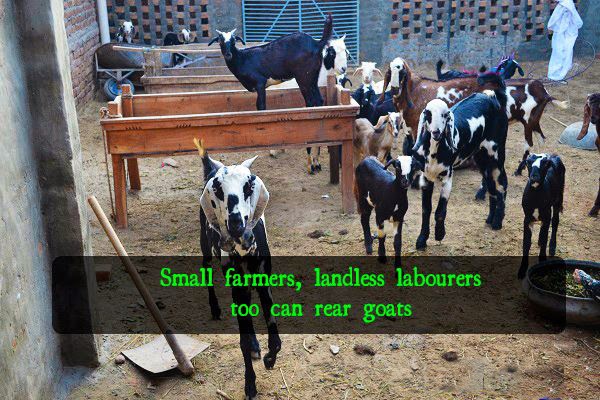
From time immemorial Indian peasants have always been rearing animals for extra income.
But now all this is changing, with shrinking pasture lands and scarcity of green fodder, rearing farm animals is being considered un-remunerative.
To encourage small farmers and landless labourers to take up goat cultivation without having to spend much, scientists from Peruvannamuzhi Krishi Vigyan Kendra of the Indian Institute of Spices Research (IISR) have fine-tuned a technology.
CAREFUL PLANNING
“Our veterinary experts, through careful planning and breeding charts, have been able to fully exploit the reproductive efficiency of female goats. In a large herd, synchronization of estrus cycle by administering PGF2 alpha injection and timely breeding by using good quality frozen semen or natural service by superior male enhances not only conception rate for a female goat, but also the farmer can bring most of the females in a herd to deliver (kidding) at a specified period. In a herd of 50 animals, we can bring 10 or 20 goats to deliver in about 150 days at a time by this method. It is a boon to the farming community,” says Dr. M. Anandaraj, Director of the institute.
The institute has also formulated a technique for raising the goat kids. After 15-30 days the kids are housed inside a shed that is made of bamboo or wood with plenty of sunlight and ventilation for 120-140 days before being sold.
ONCE A MONTH
Once in a month the kids are also allowed to suckle from its mother 2-3 times a day before completely weaning them away.
Animals grown under this method attain 25-33 kg of body weight in 4-5 months compared to those animals grown under conventional method that attain only 10 kg in six months.
Initially the kids after being weaned away from their mother are fed small quantities of concentrated feed prepared specifically by the institute's experts.
Depending on the consumption, the feed quantity is slowly increased. Additionally liver tonics mixed with fish oil are also given to increase appetite and aid good healthy growth.
Clean water is made available all through the day.
The expense for feeding one kid comes to about Rs.1,200 a month and a net income of Rs.5,000 to Rs.7,000 can be got in some months by selling the kids.
This feed is also available in the market in some commercial brand names and farmers can also make them by mixing rice, wheat, maize, horsegram etc.
CONTACT
“Farmers can contact the institute at the address given below to clarify their doubts and learn more about this,” says Dr. S. Shanmughavel, animal science specialist of the Institute.
Various women self help groups and several individual farmers in Kozhikode district, Kerala, have started to rear goats in this method for the past few years.
Low cost, better return and easy management are some of the favourable factors that motivate farmers to take up this technique.
This has become a flagship programme of our Kendra because it helps rear more number of goats in a short span of time.
“The biggest advantage is that those who have only few cents of land can also grow goats. We need not spent much time grazing them out in the open. Managing a dozen goats is not a big task now for landless workers or small farmers,” says Dr. Shanmughavel
SUCCESS
The success of this technology is not confined to Kerala alone. Farmers from other states like Karnataka, Tamil Nadu, Andhra Pradesh, and Gujarat are visiting the Institute to learn more about this method.
For more details readers can contact Dr. S. Shanmughavel, Subject Matter Specialist (Animal Sciences), Krishi Vigyan Kendra, Peruvannamuzhi Post, Kozhikode: 673 528, Kerala, email: kvk@spices.res.in, Phone:0496-2662372. and also log on to YouTube Channel (http://www.youtube.com/iisrcalicut) to watch a documentary film on broiler goat rearing practice.
Wednesday, 16 October 2013

Saturday, 14 September 2013
Goat shared common ancestor with cattle about 23mn years ago
A team of researchers has completed the first genome sequence of domestic goat by a robust approach integrated with next-generation sequencing (NGS) and whole-genome mapping (WGM) technologies.

A team of researchers has completed the first genome sequence of domestic goat by a robust approach integrated with next-generation sequencing (NGS) and whole-genome mapping (WGM) technologies.
The goat genome is the first reference genome for small ruminant animals and may help advance the understanding of distinct ruminants' genomic features from non-ruminant species. This work also yields a valuable experience for facilitating the de novo assemblies of large, complex genomes in the future.
It will be also be useful for facilitating the identification of SNP markers for marker-assisted breeding, and improving the utility of the goat as a biomedical model and bioreactor, according to researchers from Kunming Institute of Zoology, Chinese Academy of Sciences, BGI, and other institutes.
With the availability of next-generation sequencing (NGS), draft assemblies are easy to generate nowadays. However, to finish a sequence to the chromosome level remains a hard nut to crack.
In this study, the results show that a single NGS platform, when combined with whole-genome mapping technology, could produce a finished assembly much faster and with high quality than other currently available mapping strategies such as BACs or FISH. Through this integrated approach, researchers obtained the ~2.66 Gb goat reference genome from a female Yunnan black goat.
Transposable elements (TEs) are major components of mammalian genomes and contribute to gene and/or genome evolution. The TEs in goat genome are similar to those of cattle, and contain large numbers of ruminant-specific repeats, such as SINE-tRNA and SINE-BovA. It is reported that SINE-BovA repeat expanded primarily in the cattle genome.
However, in this study, researchers found the SINE-tRNA repeat expanded specifically in the goat genome.
Through constructing a phylogenetic tree among goats, cattle, horses, dogs, opossums and humans, researchers found the goat shared a common ancestor with cattle about 23 million years ago. Further comparison analysis revealed 44 rapidly evolving genes under positive selection, seven of which are immune-related genes and three are pituitary hormone or related genes. The immune-related genes identified also exist in cattle.
The findings suggest that the rapid evolution of pituitary hormones may be related to the different features between goat and cattle in milk production, development rates of the fetus and/or hair variation.
The major histocompatibility complex (MHC) plays an important role in the immune system. In this study, the goat MHC was found to be located on chromosome 23 and contains two regions with length of 2.25 Mb and 360 kb, respectively.
With the high quality genome assembly, further understanding of the goat MHC will be useful for immunological studies and vaccine development.
Researchers conducted transcriptomic analysis on the primary and secondary follicles of a cashmere goat, revealing 51 genes that are differentially expressed between the two types of hair follicles. Keratin and keratin-associated proteins are the main structural proteins of hair fibres, determining the quality of fibre together.
In the study, 29 keratin genes and 30 keratin-associated protein genes were detected in both types of follicles. Interestingly, they found two keratin genes and ten keratin-associated protein genes were consistently differentially expressed between primary and secondary hair follicles, suggesting that the keratin-associated protein genes may be more important in determining the structure of cashmere fibres.
In addition to the keratin genes and keratin-associated protein genes, researchers also found several enzymes of amino acid biosynthesis, with implications in regulating primary hair growth and hair cycle.
Xun Xu, deputy director of BGI, said, "The goat reference genome is an important stepping stone in the molecular breeding of cashmere goats, and will help to advance the comparative studies on ruminants. The transcriptomic analysis on the primary and secondary follicles will open a new way for better improving the quality cashmere wool.
The study was published online in Nature Biotechnology.
Tuesday, 3 September 2013
Goat: Man's first domesticated animal
By Henrylito D. Tacio
Sun Star

IN INTRODUCING his book, Goat Husbandry, author David MacKenzie wrote: "When man began his farming operations in the dawn of history, the goat was the kingpin of the personal life, making possible the conquest of desert and mountain and the occupation of the fertile land that lay beyond. The first of Man's domestic animals to colonize the wilderness, the goat is the last to abandon the deserts that man leaves behind him."
MacKenzie further wrote: "Forever the friend of the pioneer and the last survivor, the goat was never well loved by arable farmers on fertile land. When agriculture produces crops that man, cow and sheep can consume with more profit, the goat retreats to the mountain tops and the wilderness, rejected and despised – hated too, as the emblem of anarchy."
Goats are considered the first hoofed animals ever tamed. In the Biblical town of Jericho, people kept tame goats as long as 6,000 or 7,000 years before Christ.
The ancient Greeks and Romans paid great attention to the rearing of goats. Anyone at all familiar with classical authors will remember how frequently these animals are mentioned, especially in pastoral poems.
In the Philippines, more and more people are now raising goats, in their farms, in their backyards, and even in their ranches.
"We have been raising goats since the early 1970s and we have observed that the demand for the animal has been growing," admitted Roy C. Alimoane, the current director of the Mindanao Baptist Rural Life Center (MBRLC) Foundation, Inc. MBRLC is a non-government organization based in the southern part of the Philippines.
Just like cows, goat is valued mainly for its meat and milk. "As a milk producer, the goat is inevitably more efficient where the available fodder is of such low quality that a cow can barely live," MacKenzie wrote in his book.
"Indeed, I find among the writers, that the milk of the goat is next in estimation to a woman; for it helpeth the stomach, removeth oppilations and stoppings of the liver and looseth the belly," William Harrison wrote, echoing the opinion of 2,000 years of medical writing.
Hippocrates commended the virtues of goats’ milk and, according to Homer, some of the gods and goddesses themselves were reared on it.
There is probably no other animal, except dog, that has a greater variety of range than the goat. "It is met with in most parts of the world, and appears as much at home in the cold regions of Norway and Sweden as in the hot countries of Asia and Africa," noted H.S. Holmes Pegler in The Book of the Goat.
Subscribe to:
Posts (Atom)