Share This

Showing posts with label India. Show all posts

Monday, 4 November 2013

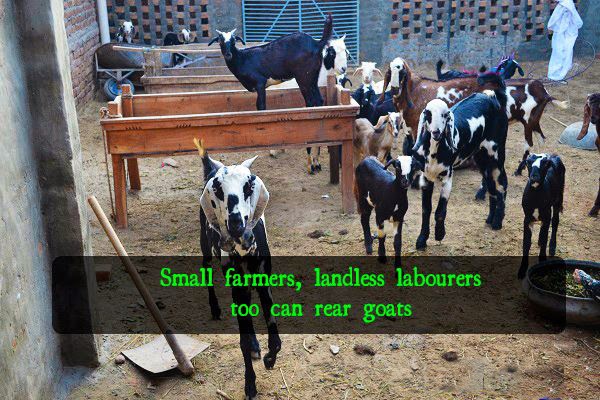
Small farmers, landless labourers too can rear goats

Small farmers, landless labourers too can rear goats


From time immemorial Indian peasants have always been rearing animals for extra income.

But now all this is changing, with shrinking pasture lands and scarcity of green fodder, rearing farm animals is being considered un-remunerative.

To encourage small farmers and landless labourers to take up goat cultivation without having to spend much, scientists from Peruvannamuzhi Krishi Vigyan Kendra of the Indian Institute of Spices Research (IISR) have fine-tuned a technology.

CAREFUL PLANNING


“Our veterinary experts, through careful planning and breeding charts, have been able to fully exploit the reproductive efficiency of female goats. In a large herd, synchronization of estrus cycle by administering PGF2 alpha injection and timely breeding by using good quality frozen semen or natural service by superior male enhances not only conception rate for a female goat, but also the farmer can bring most of the females in a herd to deliver (kidding) at a specified period. In a herd of 50 animals, we can bring 10 or 20 goats to deliver in about 150 days at a time by this method. It is a boon to the farming community,” says Dr. M. Anandaraj, Director of the institute.

The institute has also formulated a technique for raising the goat kids. After 15-30 days the kids are housed inside a shed that is made of bamboo or wood with plenty of sunlight and ventilation for 120-140 days before being sold.

ONCE A MONTH


Once in a month the kids are also allowed to suckle from its mother 2-3 times a day before completely weaning them away.

Animals grown under this method attain 25-33 kg of body weight in 4-5 months compared to those animals grown under conventional method that attain only 10 kg in six months.

Initially the kids after being weaned away from their mother are fed small quantities of concentrated feed prepared specifically by the institute's experts.

Depending on the consumption, the feed quantity is slowly increased. Additionally liver tonics mixed with fish oil are also given to increase appetite and aid good healthy growth.

Clean water is made available all through the day.

The expense for feeding one kid comes to about Rs.1,200 a month and a net income of Rs.5,000 to Rs.7,000 can be got in some months by selling the kids.

This feed is also available in the market in some commercial brand names and farmers can also make them by mixing rice, wheat, maize, horsegram etc.

CONTACT


“Farmers can contact the institute at the address given below to clarify their doubts and learn more about this,” says Dr. S. Shanmughavel, animal science specialist of the Institute.

Various women self help groups and several individual farmers in Kozhikode district, Kerala, have started to rear goats in this method for the past few years.

Low cost, better return and easy management are some of the favourable factors that motivate farmers to take up this technique.

This has become a flagship programme of our Kendra because it helps rear more number of goats in a short span of time.

“The biggest advantage is that those who have only few cents of land can also grow goats. We need not spent much time grazing them out in the open. Managing a dozen goats is not a big task now for landless workers or small farmers,” says Dr. Shanmughavel

SUCCESS


The success of this technology is not confined to Kerala alone. Farmers from other states like Karnataka, Tamil Nadu, Andhra Pradesh, and Gujarat are visiting the Institute to learn more about this method.

For more details readers can contact Dr. S. Shanmughavel, Subject Matter Specialist (Animal Sciences), Krishi Vigyan Kendra, Peruvannamuzhi Post, Kozhikode: 673 528, Kerala, email: kvk@spices.res.in, Phone:0496-2662372. and also log on to YouTube Channel (http://www.youtube.com/iisrcalicut) to watch a documentary film on broiler goat rearing practice.

Friday, 1 November 2013

This grape story could ring in a revolution

K. SRINIVAS REDDY
The Hindu

This grape story could ring in a revolution
Chinthala Venkat Reddy at his grape garden in Ranga Reddy district. Photo: K. Srinivas Reddy

If you have sun-dried soil, you could usher in a revolution. A grape farmer’s innovation in Ranga Reddy promises a bumper crop, sans fertiliser, pesticide and all

Can dried soil replace fertilisers and pesticides?

If the results of a novel Soil Management (SM) technique — developed by a farmer from Ranga Reddy district — are any indication, the crop yield would go up at least by half, drastically reducing the farm input cost component, even while preserving the soil eco system.

Agricultural scientists have been visiting a grape garden on the city outskirts, where the SM technique is employed by a Chinthala Venkat Reddy, a progressive farmer, leading to a phenomenal increase in yield.


Top-notch


The grapes harvested in this garden are the sweetest and the best in quality in terms of crispiness of the fruit and berry size, vouchsafe scientists of the Dr. YSR Horticultural University and the Krishi Vignan Kendra of the Indian Council of Agriculture Research (ICAR).

The technique developed by Mr. Venkat Reddy is rather simple. The sub-soil from a paddy field is scooped up using hydraulic earth movers and dried in open air during summer. This dried soil is sprinkled at the stem of the plant periodically.

“Each plant needs specific nutrients. For example, the soil nutrients needed by paddy and grape are different. When you scoop soil from a paddy field, the soil will have plenty of nutrients needed by grape plant. When the plant gets the nutrients it needs, it grows healthily without fertiliser support”, he explains.


Phenomenal yield


With this technique, Mr. Venkat Reddy (Phone: 986-688-3336) has been able to get a yield of 30-32 tonnes of grape per acre, while his counterparts in other gardens, who make use of pesticides, fertilisers and organic manure, get a yield between 20 and 25 tonnes.

“Going by the healthy plants in the garden and the grape fruits yet to be harvested, the yield could touch 40 tonnes per acre this year. It’s nothing short of a miracle,” exclaims G. Satyanarayana, Joint Secretary of ICAR’s Krishi Vignan Kendra, Gaddipalli, Nalgonda.

Dr. Satyanarayana, who has been visiting the farm, says the technique is a boon for the farming community as it is not an experiment done in a one-acre farm. There has been consistency in grape yield over the years.

Impressed by innovation and consistent high-yields at lowest cost, the centre is getting ready to do a systematic analysis of the SM technique by agricultural scientists under the Rashtriya Krishi Vignan Yojana (RKVY) Scheme, informs. B. Srinivas Rao, Principal Scientist at the Grape Research Station in Rajendranagar, Hyderabad.

Mr. Venkat Reddy claims to have tried out the technique in growing paddy and wheat too, yielding good results in the process. Encouraged by the consistency, he has also applied for a national patent for the technique. The claim has been published by the Indian Patent Office in June 2012.

Tuesday, 10 September 2013

Beekeeping offers new avenues to Amritsar farmers


Yudhvir Rana
TNN

AMRITSAR: Farmers of Amritsar have shown interest in beekeeping as they look for alternatives to supplement their dwindling incomes on account of losses due to vagaries of nature. Even the landless farmers are opting for moveable apiaries to boost their earnings by selling honey and wax.

Beekeeping offers new avenues to Amritsar farmersAbout 180 farmers from the district have taken up beekeeping as an additional source of income in the last two years courtesy subsidies and incentives offered by the horticulture department under the National Horticulture Mission.

According to deputy director (horticulture) Baaj Singh Sandhu the department encourages farmers to switch over to apiculture (cultivation of bees on a commercial scale for the production of honey) by giving various facilities and incentives. These include 50% subsidy on the purchase of wooden beehive boxes, Italian bee Apis mellifera and other beekeeping equipment from registered companies. Farmers of border villages, especially in Ajnala and Patti blocks, have shown keen interest in this allied activity.

A farmer has to shell out Rs 1.50 lakh for 50 wooden beehive boxes and spend another Rs 14,000 for other equipment, including honey extractors. "Those who can't afford to invest at the initial stage are provided loans from cooperative societies, which has encouraged several farmers to involve in beekeeping," said Sandhu.

On an average, one beehive yields around 20-25 kg honey in a year that fetches around Rs 80-100 per kg in the wholesale market. "We are trying to rope in Markfed to procure honey from the farmers and market it, which would lead to healthy competition and they would get better prices," said Baaj.

However, the apiarists have to keep the beehive boxes moving to be able to get nectar for bees round the year from the flowering plants, trees and crops in different seasons. "This also helps in pollination as bees move from one field or area to another. We are also encouraging the farmers with fruit trees to adopt beekeeping as an additional activity," said the deputy director.

An apiarist, Punjab Singh, from Ajnala said he finds it difficult to shift his beehive boxes, but it was imperative if he were to earn more from beekeeping. "I wish that the government would give the apiarists free transportation so that they could move between states to keep bees active for more honey yield." Owner of 80 beehives, Singh said honey extraction season is between November and May.

ShareThis